



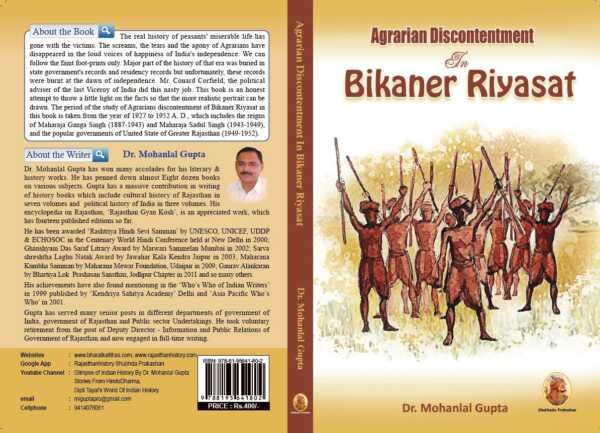
Agrarian Discontentment in Bikaner Riyasat – An important historical document of history of Thar desert
Dr. Mohanlal Gupta’s scholarly work Agrarian Discontentment in Bikaner Riyasat (Agrarian History of Bikaner) is a significant contribution to the study of Rajasthan’s socio‑economic past. The book explores the roots of peasant unrest, the agrarian economy, and the political responses of the princely state of Bikaner during the late medieval and colonial periods. By focusing on the lived realities of cultivators, landlords, and administrators, Gupta provides a nuanced picture of how Agrarian Discontentment in Bikaner shaped the trajectory of rural society in western Rajasthan.
1. Historical Context
The Bikaner Riyasat (Bikaner State) was one of the prominent Rajput princely states in Rajasthan. Its semi‑arid geography, dependence on monsoon rains, and frequent famines created a fragile agrarian structure. Dr. Gupta situates Agrarian Discontentment in Bikaner Riyasat within this ecological and political framework. He explains how scarcity of water, desert terrain, and recurring droughts intensified the hardships of peasants.
2. Causes of Agrarian Discontent
The book highlights multiple causes behind the agrarian unrest:
- Heavy taxation imposed by the princely rulers and later by colonial administrators.
- Exploitative practices of jagirdars (feudal landlords).
- Lack of irrigation facilities and dependence on rain‑fed agriculture.
- Frequent famines leading to migration and indebtedness.
Dr. Gupta argues that Agrarian Discontentment in Bikaner Riyasat was not merely an economic issue but also a social and political phenomenon. The peasants’ grievances were tied to questions of justice, dignity, and survival.
3. Peasant Movements and Resistance
One of the most engaging sections of the book deals with peasant resistance. Gupta documents how cultivators organized themselves against oppressive taxation and feudal exploitation. In some cases, they petitioned the rulers; in others, they resorted to collective protests. These movements reflected the growing consciousness among rural communities.
The narrative shows that Agrarian Discontentment in Bikaner Riyasat was part of a larger wave of agrarian struggles across Rajputana and colonial India. The book draws parallels with peasant movements in Marwar, Shekhawati, and other regions, thereby situating Bikaner within a broader historical canvas.
4. Administrative Responses
Dr. Gupta also examines how the Bikaner rulers and British officials responded to agrarian unrest. While some reforms were introduced—such as attempts at irrigation projects and partial tax relief—these measures were often inadequate. The persistence of feudal structures meant that peasants continued to face exploitation.
The book underscores that Agrarian Discontentment in Bikaner Riyasat remained unresolved until the integration of princely states into independent India. Post‑independence land reforms finally addressed many of the grievances that had simmered for centuries.
5. Cultural and Social Dimensions
Beyond economics and politics, Gupta explores the cultural impact of agrarian discontent. Folk songs, oral traditions, and local narratives often reflected the pain and resilience of peasants. These cultural expressions provide valuable insights into how rural communities internalized and resisted oppression.
Thus, Agrarian Discontentment in Bikaner Riyasat is not only a story of taxes and famines but also of human endurance, community solidarity, and cultural creativity.
6. Contemporary Relevance
The book’s relevance extends beyond historical scholarship. Modern Rajasthan still grapples with issues of water scarcity, farmer indebtedness, and agrarian distress. By studying Agrarian Discontentment in Bikaner Riyasat, policymakers and researchers can better understand the long‑term roots of rural challenges. Gupta’s work reminds us that agrarian crises are not new; they are deeply embedded in historical structures of exploitation and ecological vulnerability.
Conclusion
Dr. Mohanlal Gupta’s Agrarian Discontentment in Bikaner Riyasat is a landmark study that combines archival research, oral traditions, and socio‑economic analysis. It illuminates the struggles of peasants, the limitations of feudal and colonial governance, and the resilience of rural communities. By weaving together political, economic, and cultural threads, Gupta ensures that the story of Bikaner’s agrarian past is preserved for future generations.
Ultimately, Agrarian Discontentment in Bikaner Riyasat stands as a reminder that the voices of peasants—often marginalized in grand narratives of kings and empires—are central to understanding the true history of Rajasthan.
An introduction to important books on Indian history by Dr. Mohanlal Gupta is available on our website- Bharat Ka Itihas.
-Madhubala Gupta